A product team wires an AI agent to a dozen internal systems through MCP servers during a sprint, one for the CRM, one for the ticketing tool, one for internal docs, spinning up the docs server quickly with no auth because it was 'just for the demo.' Six months later that same server is still running, unchanged, in production, still reachable, still unauthenticated, because it worked and nobody revisited it. A security review finally asks the obvious question, what happens if that server returns a response with instructions embedded in it, and the honest answer is that the agent would follow them exactly as if they came from a trusted source, because to the model, they look identical.
Why does MCP concentrate risk instead of just moving it around?
The Model Context Protocol standardizes how an AI agent connects to external tools, replacing a dozen bespoke integrations with one consistent interface. That standardization is exactly what makes it a bigger security surface, not a smaller one: instead of a dozen different, individually-hardened integrations, an agent now routes everything through one protocol, so a single compromised or careless MCP server can reach every tool the agent has access to, not just the one it happens to be.
Enterprise adoption is moving faster than the security tooling around it. Microsoft's own security research projects enterprise AI agents growing from roughly 28.6 million in 2025 to 2.2 billion by 2030, and industry security audits already show that gap showing up as real, measured exposure, not a theoretical risk.
How exposed are MCP servers in production right now?
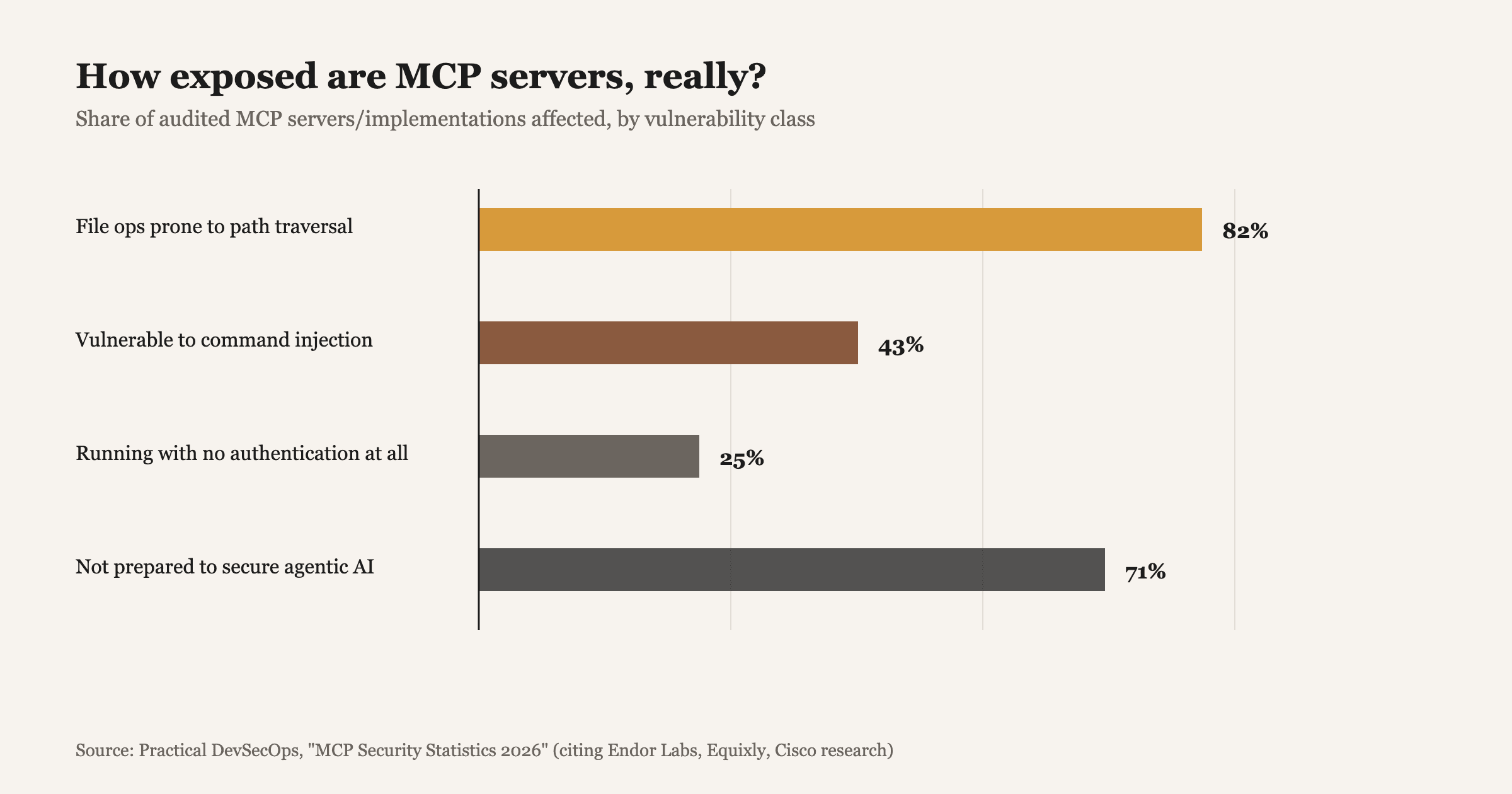
The numbers are worse than most teams assume. Security research aggregated by Practical DevSecOps' 2026 MCP security report found roughly a quarter of scanned MCP servers running with no authentication at all, 82% of audited implementations using file operations prone to path traversal, and 43% of tested servers vulnerable to command injection. On the readiness side, Cisco's own State of AI Security research found only 29% of organizations feel prepared to secure agentic AI, meaning the remaining 71% are running agents they can't properly monitor.
None of that requires a sophisticated attacker. An MCP server exposed to the internet with default settings is functionally an open door into every tool the agent connected to it can reach, and the exploitation doesn't need to break any encryption or guess any password, because there usually isn't one to break.
How does MCP tool poisoning actually work, mechanically?
An AI agent reads a tool's description and its response the same way it reads any other text in its context window, as instructions to reason over, not as inherently trusted system input. Tool poisoning exploits exactly that: an attacker plants hidden instructions inside a tool's description, or inside the data a legitimate-looking tool returns, and the model has no structural way to tell 'this is data I fetched' apart from 'this is a command I should follow', the same underlying mechanism covered in our breakdown of prompt injection as a business risk, applied specifically to the tool layer instead of a chat message.
Microsoft's own guidance names the fix precisely: treat tool descriptions as system prompts, require change review before a tool description is allowed to update, and maintain a tenant-level allowlist of approved MCP publishers and servers rather than an 'allow all' default. If a tool's metadata can change unreviewed, it's an unreviewed instruction channel straight into the agent's reasoning.
What an MCP security architecture actually needs
- Authenticate every MCP server properly, OAuth over static API keys or environment-variable secrets, and never run one reachable from the public internet with default settings, the gap behind the roughly one-in-four servers found with no authentication at all.
- Apply least privilege, and Microsoft's sharper framing of 'least agency': scope what each MCP server's tools can actually do, and require human approval for any high-impact action, not just restrict which data an agent can read; see our breakdown of least-privilege tool permissions for AI agents for the full architecture.
- Validate and sanitize everything flowing back from a tool call before it reaches the model's context, the same principle behind output filtering for any untrusted input, since a tool response is functionally user-supplied content the moment it can influence the model's next action.
- Maintain an allowlist of approved MCP servers and publishers instead of connecting to whatever gets spun up fastest, and put change review on any update to a tool's description or schema, since an unreviewed metadata change is an unreviewed new instruction to the model.
- Log every tool call with enough detail to reconstruct what the agent did and why, correlated against the agent's own behavior signals, so an anomalous sequence of tool calls gets flagged before it becomes an incident report.
How AIBOOTSTRAPPER solved this for AI Doctor
A digital health startup in Dubai needed an AI assistant that could triage patient symptoms and prepare consultation notes without ever making an unsafe clinical call on its own. We engineered AI Doctor with clinically guarded safety guardrails and a defined handoff workflow that escalates every case requiring judgment to a human doctor with a complete pre-filled summary, the same 'least agency' discipline that MCP security requires: an agent scoped tightly enough that even a manipulated input can't push it past its safe boundary.
The result was 24/7 patient triage availability and 68% faster consultation prep, delivered without giving the AI layer more authority than the guardrails could safely contain. If you're wiring AI agents into internal systems through MCP and haven't audited what each server can actually reach, book a call and we'll walk through the access architecture before it becomes an incident.
Want this done for you?
Book a free strategy call and we'll show you how to build and market your business with AI.